
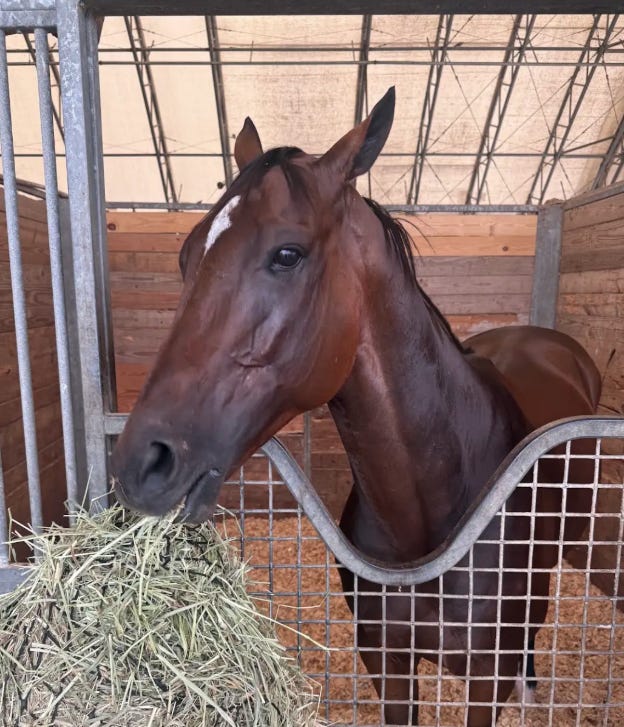
That’s a picture of Swaggish, happy as ever, in his barn stall earlier this month. But the process involved in how we claimed him out of a spring race at Tampa Bay Downs, as well as the ups and downs since that time, is a story. So here’s that story.
The Claim Game
To understand how middle-market racehorse ownership works, you have to understand the claiming box. Over 70% of all races in North America are claiming races, meaning every horse in the field has a literal price tag. If you want the horse, your trainer drops a written claim slip into a locked box before the gates open. The second the gates open, if at least one owner has entered a claim slip for a horse, barring a “voided claim,” the horse belongs to that new owner. No matter how the horse does in that race.
The previous owner earns the money from the horse’s finish in that claiming race, but the horse leaves the track wearing a red “claim tag.” And the new trainer escorts their new acquisition to their new barn.
This is what makes the claiming game the most liquid aspect of race horse ownership. And why claiming syndicates tend to attract people who motivation includes being able to see their horses run more frequently.
As my friend Howie Heiberger, Managing Partner of In Front Racing Stables, who helped introduce me to the claiming game told me, “for the horse racing fans who want lots of action, claiming gives them that.” So true!
How Swaggish Ended Up Wearing Our Silks
When our syndicate set out to acquire our first runner, we targeted a 5-year-old named Swaggish. We liked the fact that he has competed well with stronger horses than the $20,000 claiming level he was racing at that April day at Tampa Bay Downs. We also liked his speed figures and his physical build. That his name was pretty cool was not a factor in the decision, but it certainly was a positive point!
But we weren’t the only ones.
When the race ended, 13 different trainers had dropped claim slips on the same horse. In racing, when multiple people claim the same runner, it comes down to a “shake.”
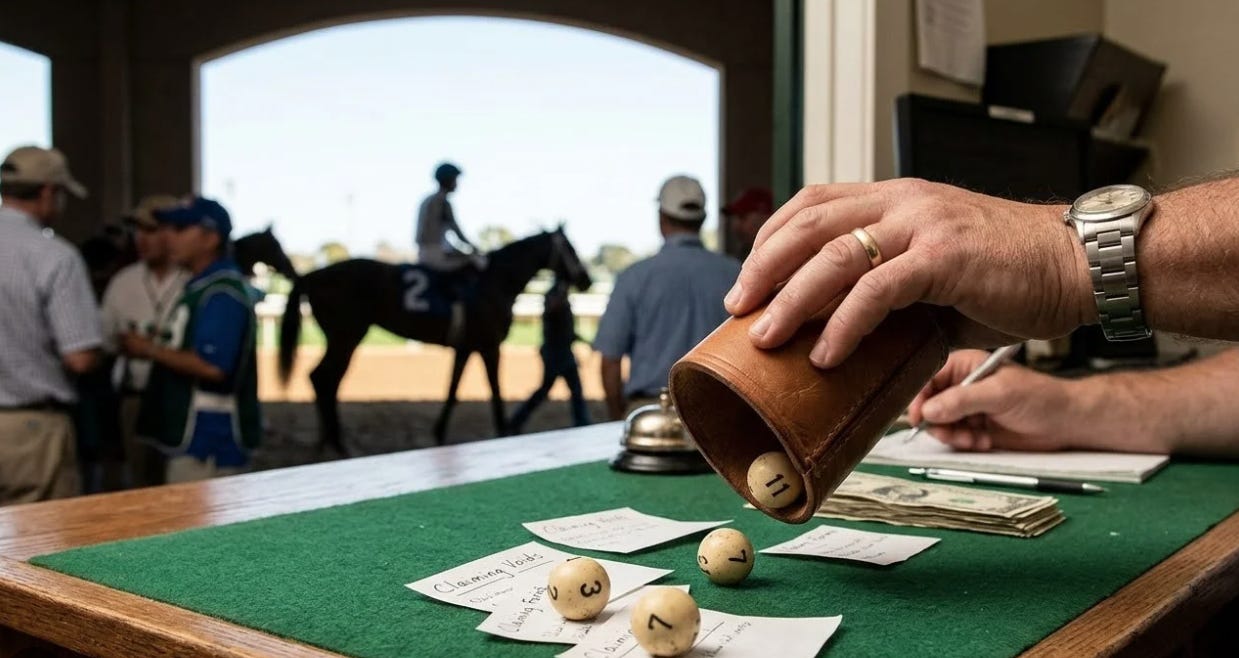
The track stewards put 13 numbered pills into a plastic bottle, shake it up, and pull one out. Whoever’s number pops out walks away with the horse.
Against a 13-to-1 shot in the racing office, our pill came up. Just like that, we were in business. If we still read physical newspapers and took photos with cameras that were just cameras, I might have this framed on my office wall. But instead, I cut-and-pasted this here.
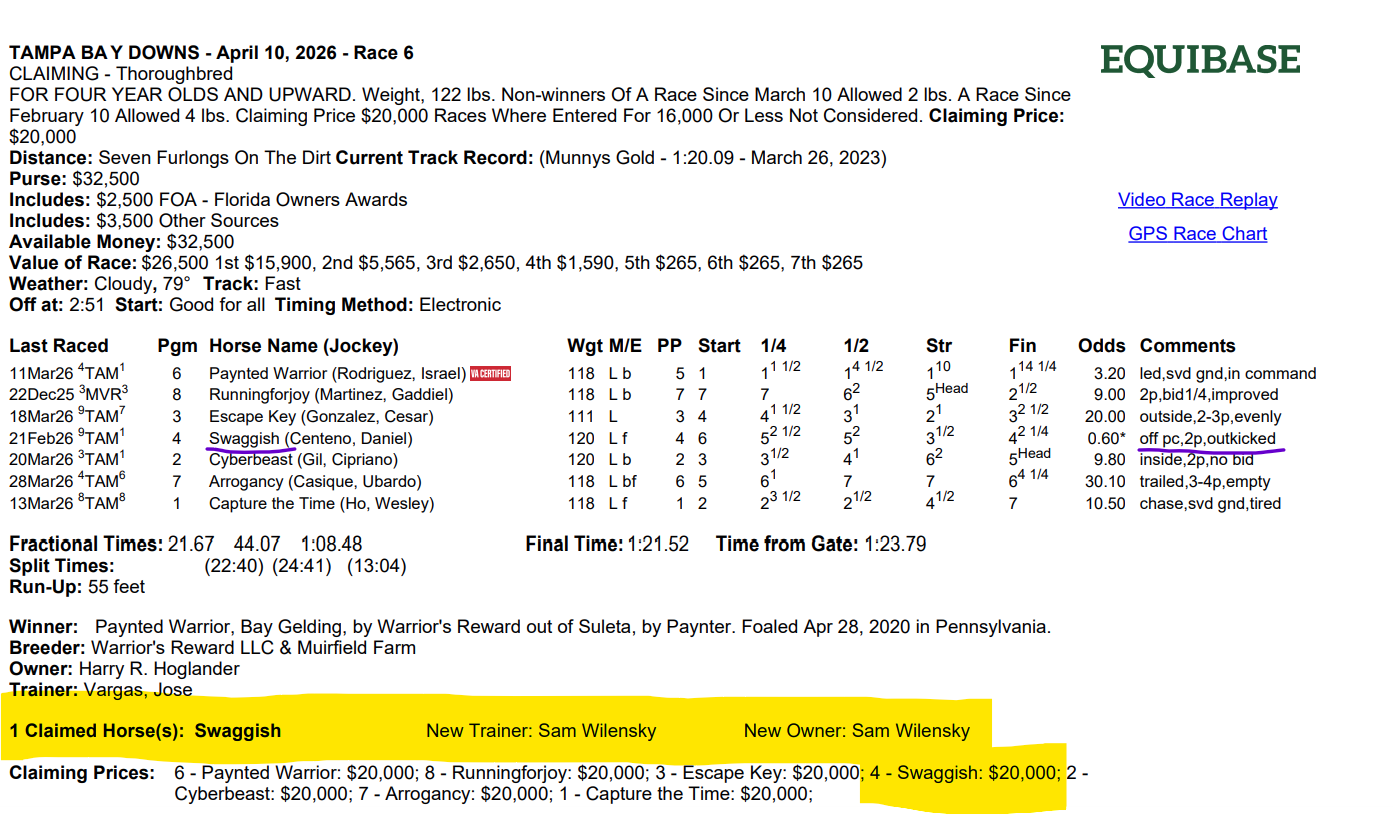
It is a digital “souvenier” of the event that made me a racehorse owner. Along with several experienced owners and others like me who were new to this part of the game.
How it started, how its going
What happened with Swaggish over the next few months was, in retrospect, exactly what those of us who are not lifelong horsemen needed. I’ll continue the Swaggish story in an upcoming post.
As of this writing, he’s still a happy member of our stable, as you saw in the picture at the top of this article. But this is claiming, where you control which horses you own, buy and sell. Up to a point, that is.