

As a longtime baseball fan, every year I experience the same “Pavlovian” response. The weather gets warmer, and that means baseball season is starting. Now, I live in South Florida, so we are talking about temps lifting from 75 degrees to 85 some days. But for those in most of the US, the start of baseball and the end of a long winter can be thought of as the same.
But what about horse racing?
With each passing year, as my interest in horse racing grew, I came to have an identical “spring is here” feeling about the sport of horse racing. It is not just the Kentucky Derby that first Saturday in May, and the Preakness and Belmont Stakes to follow. It is the quick transition from watching races at Aqueduct and Parx in the snow, rain and overall greyness, to opening days at Keeneland, the Horseshoe in Indianapolis and elsewhere. Game on!
So we made it through the winter. Happy spring. And while the Triple Crown races will get the major headlines, as racing pros will tell you, this is also peak claiming season. So let’s get you caught up.
🟥 [ 1 ] WIN: Mon–Tue Recap (4/6–4/7)
The mid-week session was defined by high-velocity turnover at regional hubs as the industry digested the massive “Varsity” openings from the weekend. With the major Kentucky and New York circuits taking their standard early-week dark days, the claiming box action migrated to Parx, Mahoning Valley, and Will Rogers Downs, where stables aggressively monetized fit winter stock to fund their spring campaigns.
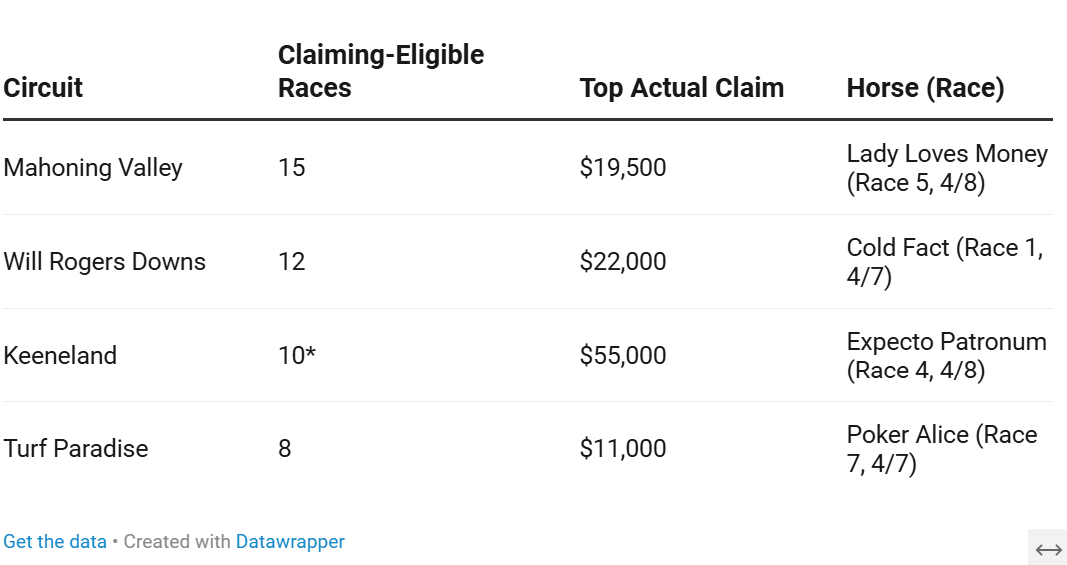
Monday’s 6th at Parx featured a high-intent acquisition of Master of None for $25,000. Secured by the Trevor Gallimore barn, this move represents the ultimate “Spring Pivot”—taking a fit, winning athlete coming off a sharp mile performance to anchor a Mid-Atlantic roster just as the regional stakes schedule begins to expand.
⬜ [ 2 ] PLACE: Three Big Mid-Week Stories
The CDI “HISA” Victory Legacy: The legal landmark out of Kentucky continues to dominate backside conversation. The federal court’s ruling in favor of Churchill Downs Inc. (CDI)—declaring HISA’s purse-weighted fee methodology “arbitrary and capricious”—is now being implemented. For claiming owners, this ensures that regulatory costs are tied strictly to racing starts, providing a predictable, transparent line item for stable overhead.
The “Strike The Top” Upset: Monday’s opener at Mahoning Valley saw 16-1 longshot Strike The Top secure a gritty win in a $10,000 claiming event. For the savvy scout, this race was a reminder that “winter-fit” horses from smaller circuits are currently outrunning their odds against higher-class “shippers” who are still acclimating to the shifting spring track cushions.
Turf Paradise “Starter” Surge: We saw a significant uptick in Starter Optional Claiming entries in Arizona this week. Stables are using these “protected” spots to run consistent winners without losing them to a claim, signaling that owners are holding onto their “bread-and-butter” earners as they prepare for the summer move to Del Mar or Emerald Downs.
🟦 [ 3 ] SHOW: Industry News & The Manual
Industry News: Safety Metrics Update: On Wednesday, HISA released its latest safety audit, highlighting that pre-race veterinary interventions at high-volume claiming tracks have reduced racing-related incidents by 12% year-over-year. For owners, this means the “merchandise” you are claiming is coming from a safer, more transparent environment.
The “Show” at Oaklawn: This Saturday features the $500,000 Count Fleet Sprint Handicap. While the stars take the stage, keep an eye on the $30,000–$50,000 older horse claims on the undercard. As the Oaklawn meet enters its final weeks, trainers are pricing horses for immediate turnover to avoid shipping costs back north.
📘 THE CLAIMER’S MANUAL
Tip: The “Surface-Switch” Pedigree Play
As we transition into the heart of April, many trainers start “experimenting” with turf on horses that have spent the winter on dirt.
The Logic: A trainer may enter a horse for a $50k tag on the grass for the first time, not because the horse is failing, but because they are testing a theory. If the horse has a “turf-heavy” bottom half of the pedigree (damside), the trainer might be trying to “steal” a win before moving them up to stakes.
The Play: Don’t just look at the dirt speed figures. Check the Sire’s Turf Win % and the Dam’s previous foals. If you see a horse entered for a tag that has never touched the grass but is sired by Kitten’s Joy, Oscar Performance, or War Front, drop the slip. You aren’t just claiming a horse; you’re claiming a potential turf specialist at a dirt-market discount.
📋 APPENDIX: The Claimer’s Glossary
Designated Race: A specific race where “Waiver Claiming” rules are automatically in effect, or where the “Right of First Refusal” is held by a state-bred breeding fund.
Split Sample: When a horse is claimed and sent to the test barn, a second sample is kept in reserve. If the primary test is positive for a banned substance, the new owner can request the “split” be tested at an independent lab before the claim is voided.
Purse-to-Claim Ratio: The critical “ROI” metric. Professional claimers look for a ratio of at least 2:1 (e.g., a $50k purse for a $25k claiming price). Anything lower is considered a “high-risk” move usually reserved for clearing stall space rather than turning a profit.
Back-Up Slip: A second claiming envelope held by a trainer at the window. If their primary client’s “Pill” (random draw) loses, the trainer can immediately drop a slip for a secondary client if the horse was eligible for multiple claims.
The “Scratch” Rule: In many jurisdictions (like New York and Kentucky), if a horse is claimed but is subsequently “scratched” (withdrawn) at the gate by the track vet, the claim is voided, and the horse returns to the original owner.