
If you’ve been around Wall Street or the investment world for five minutes, you’ve heard the old saying: there’s no such thing as a free lunch. Very often, things come with a cost, a catch, or a hidden fee.
In horse racing, that happens as well. But when you look at how racetracks compete for horses across the national map, you run into one of the rarest setups in sports: a track willing to hand you extra prize money and a cash bonus just for pulling your horse trailer into their barn area, and racing during their meet.
They call it a Ship & Win program, and it’s about as close to a “free lunch” as a racehorse partnership is ever going to find.
Why Racetracks Hand Out “Free Money”
To understand why a racetrack would pay you just to show up, you have to understand how track economics work. A racetrack isn’t just a sporting venue; it’s a wagering marketplace. The lifeblood of that marketplace is “field size.” That’s the number of horses running in each race.
Bettors dislike small fields with four or five horses because the payouts are tiny. But when a race has nine, ten, or twelve horses, the betting pools explode. More horses equal more betting handle, which generates higher revenues for the track. It also appeals to those (like me) who are very light bettors, but enjoy the challenge of analyzing and winning.
So, to attract horses from other states and fill up their daily race cards, major tracks created Ship & Win incentives.
The mechanics are simple:
Guaranteed Starter Bonuses: A flat cash check paid to the owner just for making an out-of-state horse’s first start at the meet.
Purse Enhancements: A percentage boost added on top of whatever prize money the horse earns in its races.
Del Mar in Southern California pioneered the modern Ship & Win format back in 2011 to revive its summer field sizes, and it set off a trend across the country. Today, you see similar starter bonuses and shipping incentives popping up at tracks like Saratoga and the new Belmont Park in New York, Oaklawn Park in Arkansas, and others. Particularly for meets like Del Mar, which is primarily a 2-month season from mid-July through Labor Day, providing some incentive helps all around.
Evaluating the “Free Lunch”
For a syndicate like ours (Claim To Fame Racing Club), looking at the national map through a Ship & Win lens is just smart business. And one of many ways in which we are trying to clearly differentiate our approach to the racehorse ownership business.
The Upside: It boosts the earnings potential of a standard race without requiring your horse to step up into harder competition. The guaranteed starter bonus helps offset the cost of cross-country transport, while the extra purse percentage gives your partners a much higher return when your horse runs well.
The Catch: It’s only a “free lunch” if the horse handles the trip. Shipping horses across state lines involves travel stress, climate adjustments, and new track surfaces. If a horse doesn’t settle in or dislikes the local dirt, those financial bonuses don’t mean much. That’s what we rely on our expert horsemen, Sam Wilensky and Victor Collazo, to weigh in making those decisions for us.
When we first raised “friends and family” capital for Claim To Fame Racing Club earlier this year, we felt compelled to devote a full page to it in our “pitch deck.” Here’s what that looked like.
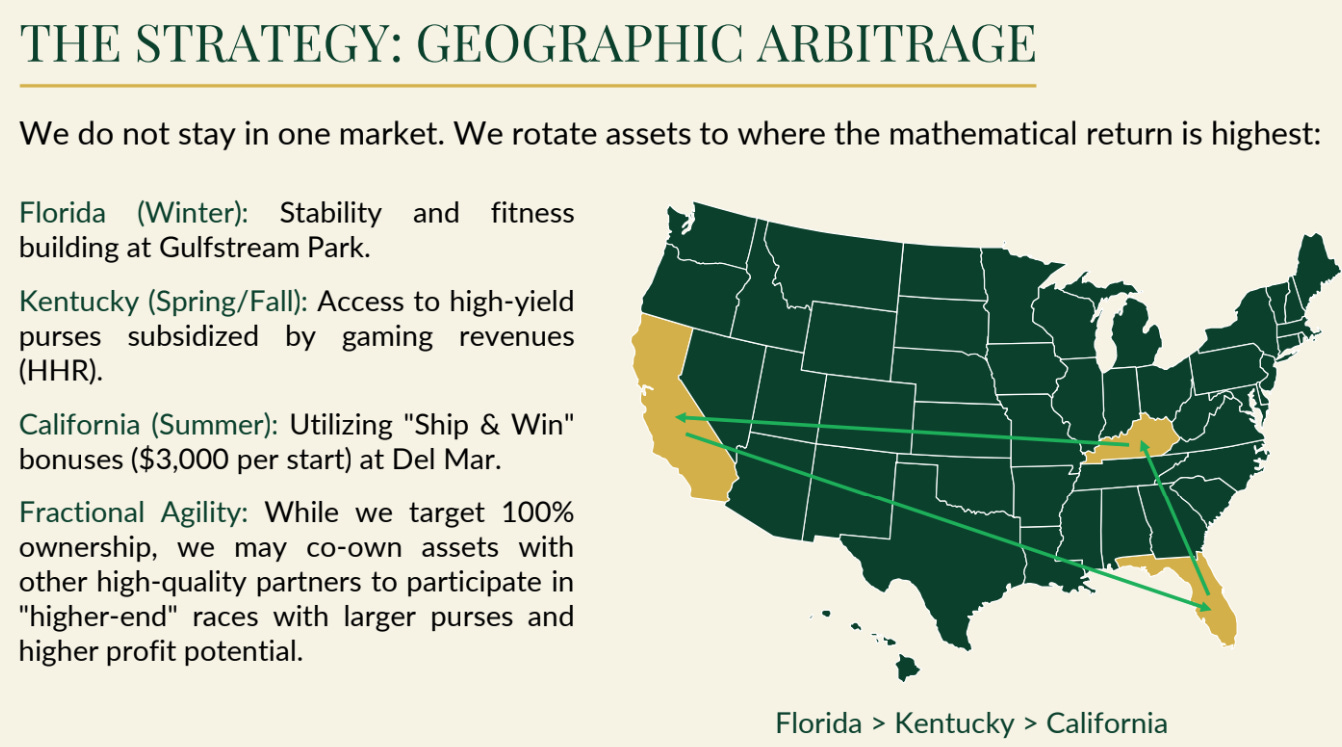
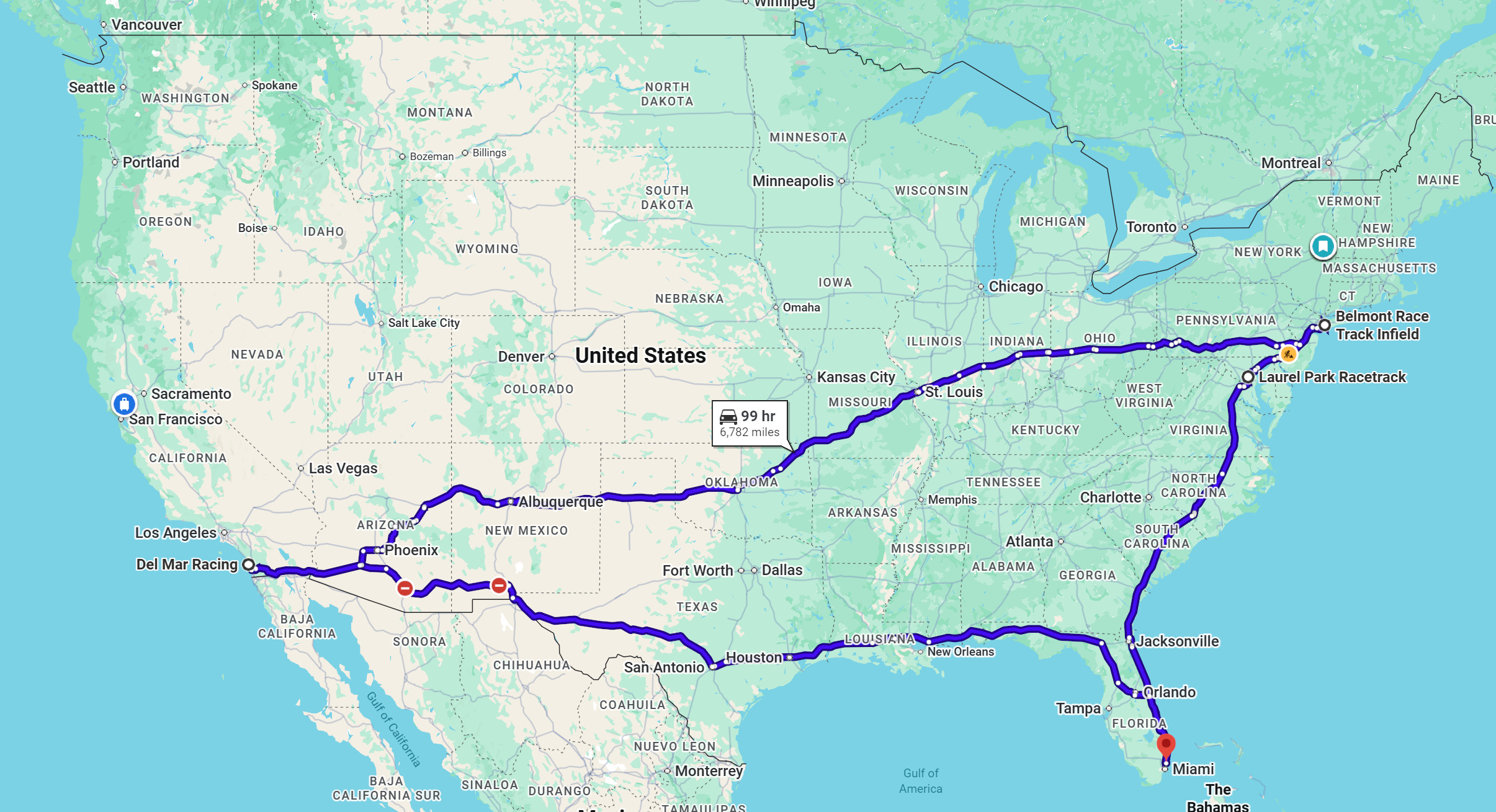
As it turned out, the opportunities were even more diverse than that simple 3-city outline above. That picture at the top of this article, the one showing a multi-city trip that my wife noted looks a lot like the state of Kentucky (though that state was not one of the stops)? That is the path that one of our horses, the veteran runner Lure Him In, has taken since July.
He shipped to Del Mar and ran there and when that season ended, we shipped him to NY with plans to run in the Northeast at least once. But the races we targeted for him did not fill up, so our horsemen adjusted with the flow, so to speak. He ran at Laurel, did very well, and now joins the rest of our crew at our Gulfstream Park home base for the winter season. Unless, of course, an ideal race pops up for him elsewhere. That’s “Geographic Arbitrage!”
Keep in mind that many horses could not be “road warriors.” But “Big Lu,” who I featured in my last post here, is no ordinary horse. He’s a 9-year old inspiration. In the same way that my brother has logged so many airline miles during his career as a healthcare executive, I know it is more than I could handle.
But apparently, based on attitude and performance, some horses thrive on it. As the horseman always tell me, horses are as different as people. And frankly, while the horse cannot “tell” us what they think of the travel/no travel paradigm, they do in other ways.
Which is why horse care is the priority. No matter how much money might be on the line in some other state or city.
When we evaluated our own stable’s needs, cooler weather and strong racing setups, plus taking advantage of a circuit like Del Mar made complete sense for our runners. Sam has been racing there for years, and knows the territory. The ocean breezes provided a fantastic environment for the horses, and the Ship & Win economics made the trip worthwhile.
And, it doesn’t take a Ship & Win incentive for us to ship a horse to run somewhere else. Remember, South Florida, where we are most of the year, is at the southeast tip of the US. You can drive for 6-10 hours depending on direction, and STILL be in Florida! And Gulfstream and Tampa Bay Downs are the only two tracks in the state. Tampa runs about half the year, and GP all year round. So getting on the road is part of how we seek to gain a long-term edge.
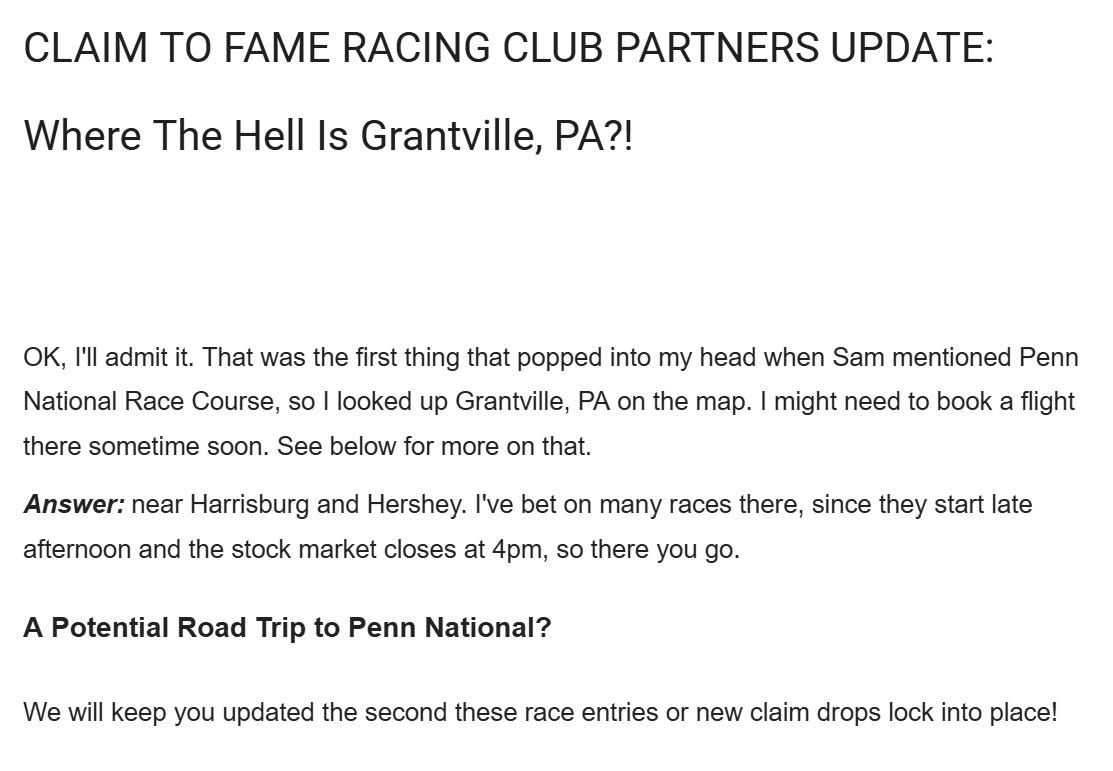
To that end, here’s a segment of a partners update note I sent out several months ago, when we were looking at potentially running one of our horses at Penn National.
Race Day On The Road
Because our partner group is spread out across Florida, Pennsylvania, New York, and beyond, shipping out West gave birth to what we call “California Streaming.”
When race day arrives in San Diego, everyone tunes in remotely. We pull up live video broadcasts on laptops and phones, fire off comments via text, and watch the odds shift right up until post time. When the starting gate opens, the adrenaline is identical whether you’re sitting in a grandstand box at the finish line or watching on a tablet from your kitchen counter 3,000 miles away. I’ve already (happily) responded to last-minute requests for “where can I watch the race live?”
We started this initial group as a small, closed partnership of friends and family to test our operational model and get our horses to the track. We aren’t taking on new investors right now.
Down the road, our goal is to open future partnership groups that bring more fans into the fold. Giving people a clear, transparent look at racehorse ownership without needing a fortune.
For now, the best way to experience what we’re doing is simple: follow along right here on the blog. And tell your friends and family that you think may be interested. It costs zero, and eventually we’ll be running events like “Owner for a Day” meetups at the track. Regardless of your interest level, we invite you to enjoy the ride with us.
Hey, I think I just told you the other free lunch in horse racing.