

🟥 [ 1 ] WIN: Weekend Composite (4/10–4/12)
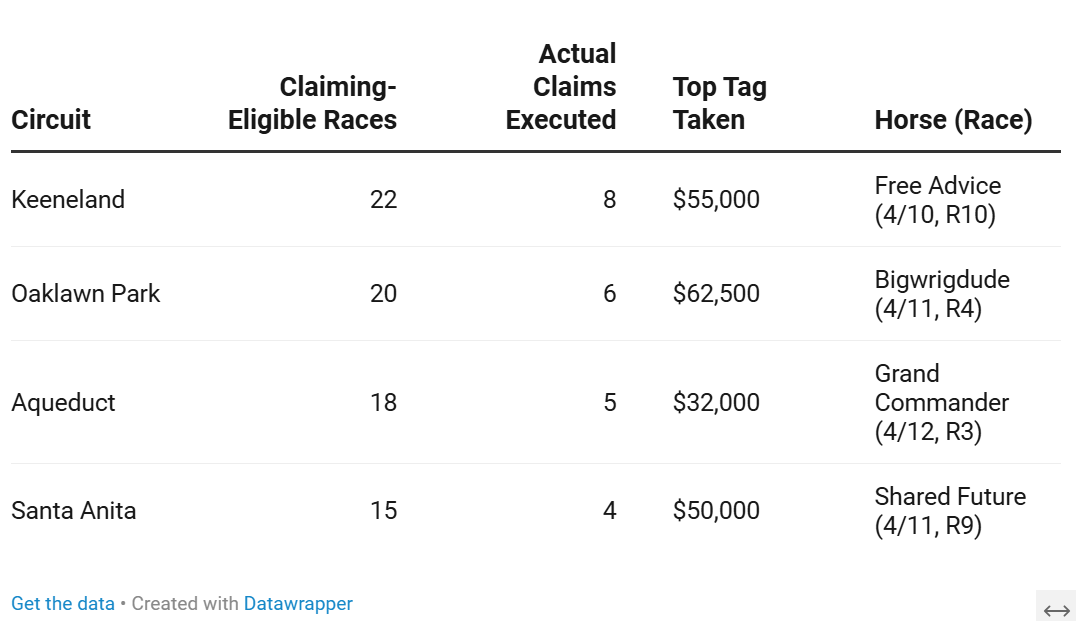
Following a full audit of the weekend charts, we have reconciled the data to distinguish between total “Claiming-Eligible” opportunities and actual “Claims Executed.” The weekend was defined by high-intent strikes at the top of the market, particularly in the three-year-old divisions.
⬜ [ 2 ] PLACE: Three Weekend Stories to Watch
The $55,000 “Advice” Score (Keeneland): Friday’s finale provided the weekend’s most discussed tactical acquisition. Free Advice didn’t just win—he dominated by 3 lengths. Secured by the Dylan Machado barn, this fit 3-year-old sprint winner is a textbook “Varsity” roster play for the upcoming Churchill Downs meet.
Oaklawn’s Final-Weeks Churn: Saturday’s $62,500 claim of Bigwrigdude involved a heavy “shake” at the window. As the Arkansas meet winds down, trainers are aggressively liquidating fit veterans to fund their northern moves, creating a high-velocity market for proven winners.
The New York “Commander” Move: Sunday’s 3rd at Aqueduct saw a sharp strike on Grand Commander ($32,000). With the New York turf season officially set to launch this Thursday, owners are securing fit dirt-specialists as a “hedge” against spring rains that frequently force early-season races off the grass.
🟦 [ 3 ] SHOW: Industry Pulse & Lifestyle
The “Show” - Lexington Tech: The atmosphere at Keeneland was unmatched, fueled by the new Paddock Building suites. Inside, there was “Syndicate Scouting” taking place—micro-share groups using 4K monitors to analyze a horse’s hock action and muscle definition in real-time. Scouting has officially moved from the rail to the digital suite.
Industry News - Regulatory Transparency: Backside energy remains high following the CDI legal victory regarding HISA fee structures. With future costs now tied strictly to racing starts rather than purse size, owners were notably more aggressive in the box this weekend, confident in their fixed overhead projections for the 2026 season.
The shift in HISA (Horseracing Integrity and Safety Authority) fee structures represents a major win for high-purse tracks and a significant change in how the industry funds its safety and drug-testing programs.
Here is the breakdown of why this matters, the legal drama behind it, and the “winner vs. loser” reality of the new math.
HISA fee structure: Old Way vs. New Way, Explained
The Old Way: Purse-Weighted (2022–2025)
Originally, HISA calculated fees based on two factors:
Racing Starts: The total number of horses running in races.
Purse Size: The total amount of prize money paid out.
The Logic: HISA argued that tracks with bigger purses (like Churchill Downs or Saratoga) generate more revenue and should pay a higher “fair share” to cover the Authority’s costs. It acted like a progressive tax: the wealthier the track, the higher the HISA bill.
The New Way: Starts-Only (Effective 2026)
Starting January 1, 2026, the formula was simplified. It now ignores purse money entirely and charges a uniform fee per racing start.
The Logic: Critics, led by Churchill Downs Inc. (CDI), argued that HISA’s actual costs (vet inspections, drug tests, surface monitoring) are the same whether a horse is running for a $5,000 purse or a $1,000,000 purse. Therefore, they argued, the fee should be a flat service fee per horse, not a percentage of the prize money.
📘 THE CLAIMER’S MANUAL
Tip: The “Second-Off-The-Layoff” Trap
In the heart of April, many horses are making their second starts after a long winter break.
The Logic: A horse that ran a “monster” race in its first start off a 4-month layoff often “bounces” (regresses) in its second start due to the physical toll of that initial peak effort.
The Play: Be wary of dropping a high-value slip on a horse that won by multiple lengths in its return. Instead, look for the “Steady Third”—a horse that finished well but didn’t exert 100% in its return. Those athletes are usually primed to peak in their second start back.
📋 APPENDIX: The Claimer’s Glossary (New Additions)
Designated Race: A specific race where “Waiver Claiming” rules are automatically in effect, or where the “Right of First Refusal” is held by a state-bred breeding fund.
Split Sample: When a horse is claimed and sent to the test barn, a second sample is kept in reserve. If the primary test is positive, the new owner can request the “split” be tested at an independent lab before the claim is voided.
Purse-to-Claim Ratio: The critical “ROI” metric. Professional claimers look for a ratio of at least 2:1 (e.g., a $50k purse for a $25k claiming price) to ensure the win pays for the investment immediately.
Back-Up Slip: A second claiming envelope held by a trainer at the window. If their primary client’s “Pill” (random draw) loses, the trainer can immediately drop a slip for a secondary client if the horse was eligible for multiple claims.
The “Scratch” Rule: In many jurisdictions (like NY and KY), if a horse is claimed but is subsequently “scratched” at the gate by the track vet, the claim is voided, and the horse returns to the original owner.